As part of the “Key Practitioners in Art and Communication
Design” series of lectures this term, we are going to be looking at singular
works, or a singular artist and their accompanying body of work each lecture.
We are going to be examining how things are made, the meaning of a piece and
how it works. This involves analysing the practise behind a piece to understand
how it has been put together.
After attending the lecture I watched the interview with Martha Rosler that was suggested. This has fed further into my understanding of the topic and can be viewed at the end of this post.
After attending the lecture I watched the interview with Martha Rosler that was suggested. This has fed further into my understanding of the topic and can be viewed at the end of this post.
The focus of today's lecture was Photographer Martha
Rosler, whom started to become noticed in the 1970’s for her pieces around
representation. Documentary photography was becoming more prolific at this
point and in particular the subject was usually focused on the “other”, that
being people whom are culturally different from the majority. By culturally I
am talking about wealth, where they sit on the class system, gender and race
while there was also a focus on the “strange” or unusual. Rosler wanted to not
condone, but question the ethical and moral standing of this style of photography.
She created photographs herself as a way to auto-critique the method and
examine how it was and still is being used. Rosler wanted to capture a history
of these people considered “other” in a way that would question the practises
of the time. However Rosler didn’t want to infringe the rights to privacy she
believes the homeless and unusual should have.
 |
| Martha Rosley - The Bowery in two inadequate descriptive systems - 1974/75Sourced from afterall.org |
She achieved this by photographing Bowery in New York, which
was considered a skid row, meaning a place where only those worse off would
reside, so to speak. However by including their absence this removed the
intrusive invasion of their space and allowed the photos form and setting to be
the focus, therefore bringing attention to the style of photography. Rosler
called the compilation “The Bowery in two inadequate descriptive systems”. Two
inadequate systems, as not only did it comprise of photographs but also the
written word, that which describes the homeless, as they are perceived. Her
choice of title at first strikes me as though she is referring to her own work
as “inadequate”, though on consideration she may be indirectly referring to the
documentary photographers’ who practised that which she questioned and those
who wrote articles about the poverty as being inadequate in describing their experience.
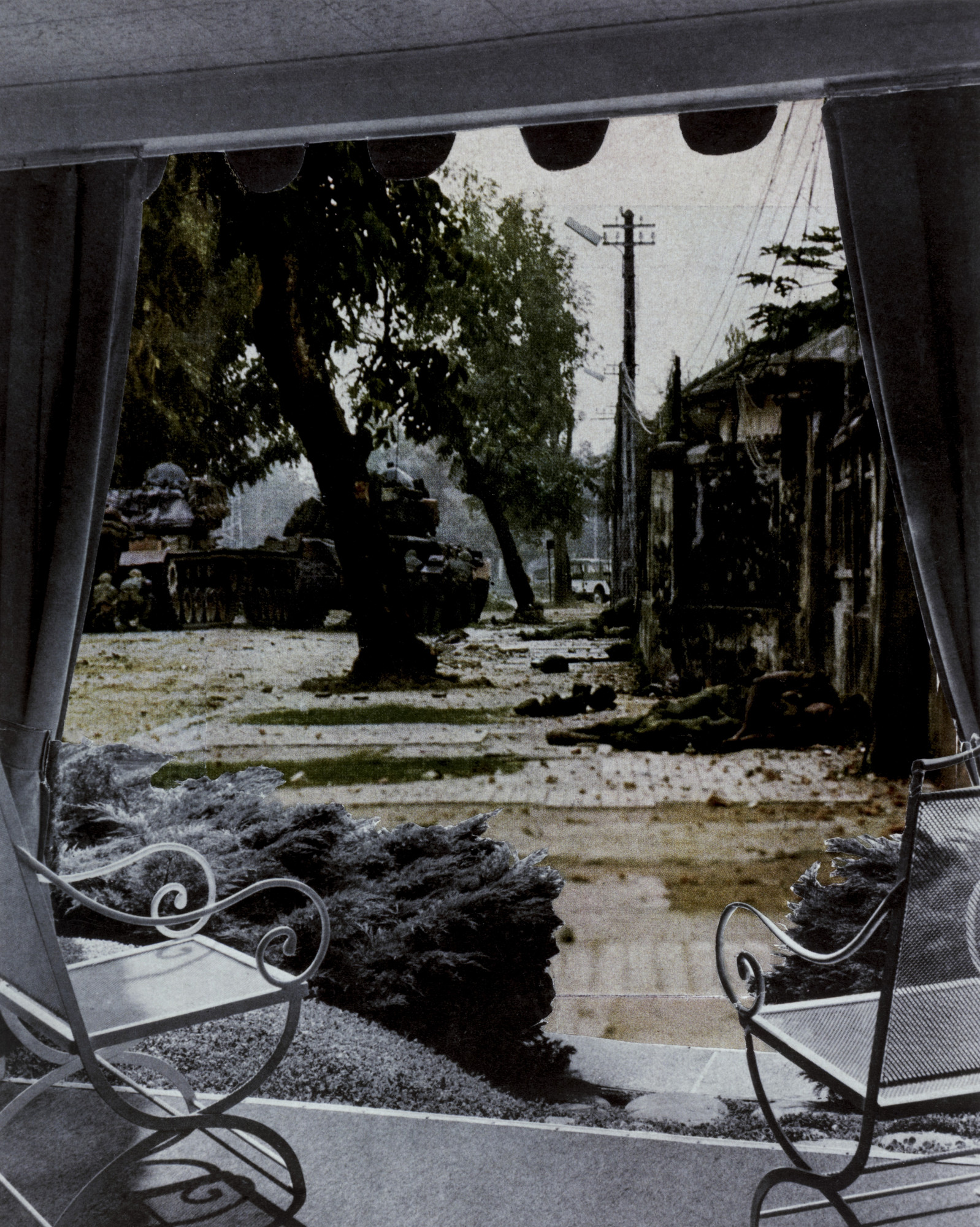 |
| Martha Rosler - Patio View - 1967-72 Sourced from moma.org |
Due to the considerable length of my understanding and analysis, I will continue this topic on a further post. Below is the video interview with Martha Rosler as mentioned.


No comments:
Post a Comment